
AI content generation for SEO isn't a shortcut. Done well, it's a structural advantage. The core answer: AI-assisted content workflows help websites produce search-optimized material faster, at greater scale, and with more consistent alignment to search intent than traditional manual methods. But not all AI content approaches deliver equally, and the difference between helpful automation and algorithmic filler often comes down to how the tool is used.
Below are the seven benefits that matter most, along with an honest look at where AI generation adds real value and where it still needs a human hand.
Why AI Content Generation Actually Changes the SEO Equation
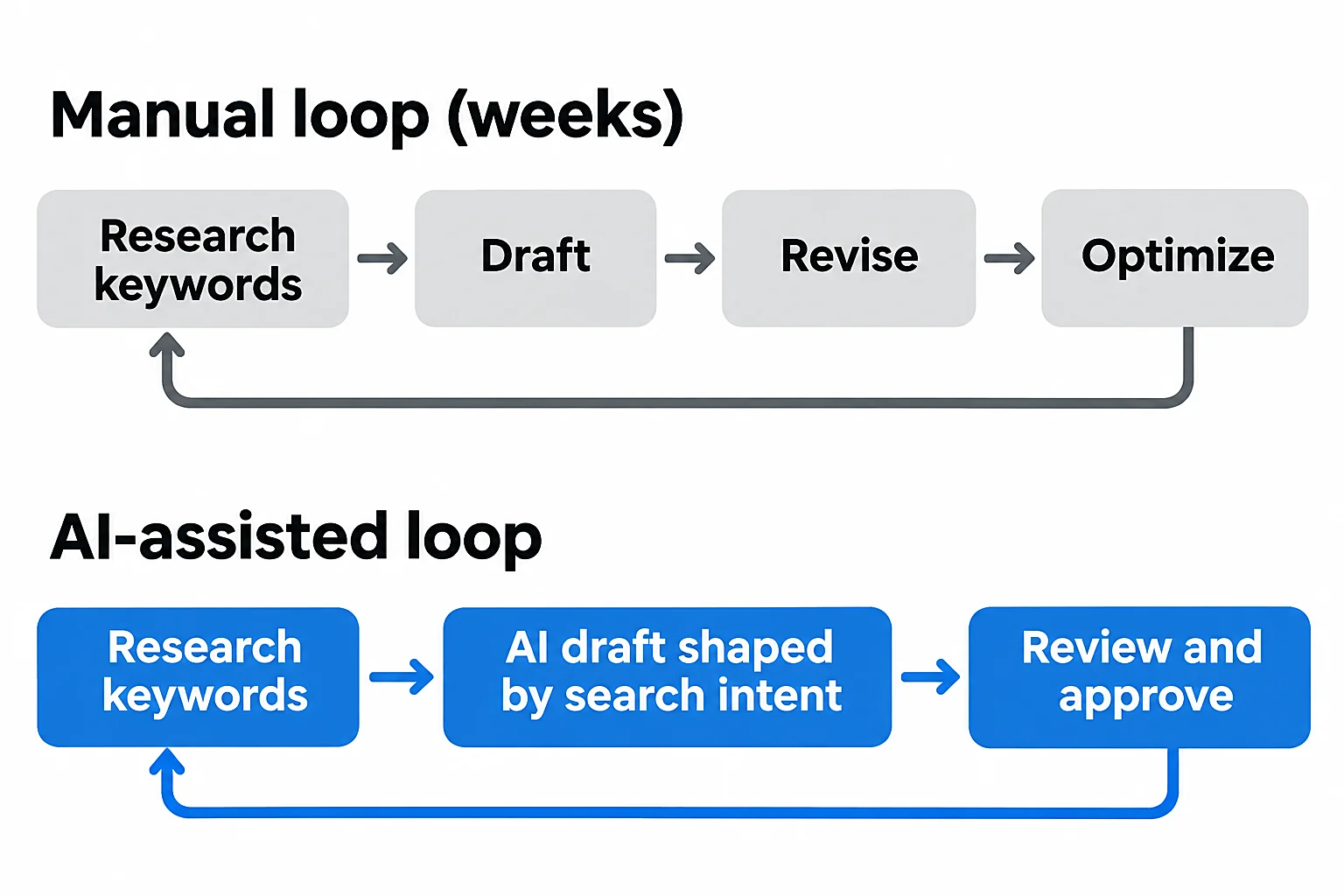
Most conversations about AI content focus on speed. Speed matters, but it's the least interesting part of what's changed. What AI content generation for SEO actually shifts is the feedback loop between research, writing, and optimization. Previously, that loop took weeks. A strategist would research keywords, a writer would draft, an SEO would revise, and the cycle would repeat.
AI collapses that loop. A tool that understands search intent, heading structure, and entity relationships can produce a working draft that's already shaped around what Google and AI answer engines like Google AI Overviews, ChatGPT, and Perplexity are looking for. That's not the same as a final article. But it's a meaningful head start.
For teams managing franchise SEO across dozens of locations, or agencies running SEO agents that handle multiple client accounts simultaneously, this compression matters enormously.
Benefit 1: Content That Matches Real Search Intent
Answer-first: AI tools trained on search data produce content that aligns with the actual intent behind a query, not just its surface keywords.
Search intent is the dimension most manual content workflows get wrong. Writers optimize for the keyword they're targeting rather than the question the searcher is actually asking. AI generation, when guided by search data, inverts that instinct. The output is shaped by what ranks, which reflects what users engage with.
This has direct implications for Answer Engine Optimization, which focuses on making content citable by AI engines rather than just visible in traditional search. Intent alignment is a prerequisite for both.
Benefit 2: Scale Without Proportional Headcount
Producing 50 location pages for a franchise network, or refreshing 200 blog posts after an algorithm update, isn't feasible at normal editorial speed. AI generation makes it feasible. Not by removing humans from the process, but by handling the structural and first-draft work so editors can focus on accuracy, tone, and judgment.
For franchise SEO specifically, this benefit is enormous. Each location page needs to feel locally relevant while staying on-brand and technically sound. AI can generate the base layer; a local editor or approval workflow handles the final pass.
Benefit 3: Structured, Crawlable Content by Default
Good AI content tools output heading hierarchies, question-based subheadings, and logical document structures that search crawlers and AI engines can parse efficiently. This isn't just cosmetic. Structured content enables structured data markup, and structured data is what makes your content eligible for rich results and AI engine citations.
If you want to understand why document structure affects how AI engines cite your pages, how structured data helps AI search explains the mechanics in detail.
Benefit 4: Consistent Quality Across a Large Content Library
Manual content quality drifts. Writer A follows H3 subheadings. Writer B doesn't. One article includes FAQ schema. The next doesn't. Over a 500-page site, that inconsistency becomes an audit headache.
AI generation enforced through a consistent prompt framework produces content that follows the same structural rules every time. That consistency is auditable, correctable, and scalable. It also means your complete AI SEO audit checklist can surface real problems rather than chasing formatting noise.
Benefit 6: Faster Iterations When Algorithms Change
After a core update, the sites that recover fastest are the ones that can diagnose what changed and produce new content quickly. Manual shops wait weeks for a writer's availability. Automated content workflows can respond in days.
This is where AI SEO services and SEO agents start to converge. An agent that monitors performance, identifies pages with declining visibility, and queues updated content for editorial review compresses the recovery cycle dramatically.
Benefit 7: Integrated Optimization Without Post-Production Fixes
The old model: write the content, then layer in SEO. Title tags adjusted separately. Meta descriptions written after the fact. Internal links added in a second pass.
AI content generation, when integrated with a site's technical layer, can output content where the SEO elements are built in from the start. Raechal AI, for instance, generates content based on audit insights and surfaces approval-ready drafts that already include metadata, heading structure, and internal linking recommendations, before a single character hits your CMS. That integration eliminates the production gap that slows most content teams down.
How to Choose the Right AI SEO Content Approach
The tools in this space vary significantly in what they actually handle. Here's a factual comparison of the main approaches a buyer would consider:
| Approach | Setup Complexity | Scale Potential | Requires Editorial Review | CMS Integration | Best For |
|---|---|---|---|---|---|
| Standalone AI writer (e.g. Jasper, Copy.ai) | Low | Medium | Yes, always | Manual | Quick drafts, small teams |
| SEO platform with AI module (e.g. Surfer, Clearscope) | Medium | Medium | Yes | Limited | Keyword-guided content |
| AI SEO agent with audit loop | Medium-High | High | Approval workflow | Yes (native) | Scale with quality control |
| Custom AI pipeline (API-based) | High | Very High | Depends on build | Full custom | Technical teams, agencies |
| Full-service AI SEO platform (e.g. Raechal AI) | Low | High | Built-in workflow | WordPress, Shopify, Webflow, GitHub | Businesses wanting automated auditing + generation |
For pricing on third-party tools, check each vendor's current plans directly rather than relying on figures listed here, as these change regularly.
Generative Engine Optimization (GEO): The Angle Most Articles Miss
GEO, or Generative Engine Optimization, is the practice of optimizing content specifically so AI answer engines (ChatGPT, Perplexity, Google AI Overviews) cite it in their responses. It's closely related to traditional SEO but distinct in one important way: GEO cares about whether a passage is quotable as a standalone answer, not just whether a page ranks on page one.
Most AI content guides don't address this. They treat AI generation as a production tool and stop there. But the content you generate needs to be structured so that AI engines can extract and attribute it. Self-contained answer passages, clean document hierarchy, and factual precision are the three factors that most consistently improve GEO performance.
Frequently Asked Questions
What is AI content generation for SEO?
AI content generation for SEO is the use of artificial intelligence to produce written content that is optimized for search engine visibility. The process typically involves AI tools that analyze search intent, keyword data, and existing high-ranking content to generate drafts structured around what search engines reward. The output isn't finished copy by itself. It functions as a structured starting point that editorial review then refines for accuracy, voice, and depth. When integrated with site auditing and structured data, AI-generated content can also be optimized for AI answer engines like Google AI Overviews and Perplexity, a practice known as Generative Engine Optimization.
Is free AI content generation for SEO worth using?
Free tiers from AI writing tools typically cap output volume and limit SEO-specific features like keyword targeting and heading optimization. For small sites or one-off tests, a free plan can produce usable drafts. For ongoing SEO at any real scale, the limitations become a bottleneck quickly. Check the current plans from tools you're evaluating, since most free tiers change their limits frequently.
How does AI content generation help franchise SEO?
Franchise SEO requires producing location-specific pages at scale while keeping each one on-brand and technically sound. AI generation handles the structural and templated elements across all locations simultaneously, leaving local editors to refine regional details. This approach makes it realistic to maintain a distinct, optimized page for each location rather than near-duplicate content that search engines tend to discount.
What's the difference between AI SEO agents and regular AI writing tools?
An AI writing tool generates content when you ask it to. An SEO agent monitors performance data, identifies pages that need attention, and initiates content updates as part of an automated workflow. Agents typically integrate with site auditing, which means the content they generate is informed by real performance signals rather than prompt inputs alone.
Can AI-generated content rank in Google?
Yes. Google's guidance confirms that content is evaluated on helpfulness and quality regardless of how it was produced. AI-generated content that is accurate, well-structured, and genuinely useful to the reader can rank. Content that is thin, repetitive, or generated purely to fill keyword slots is what Google's quality systems are designed to filter out.
Check Where Your Site Stands
Run your site through the complete AI SEO audit checklist to see exactly where your content, structure, and authority signals stand today, and which pages are ready for AI-assisted improvement.